How Many Practice Hours Does a Teen Driver Need in Minnesota?

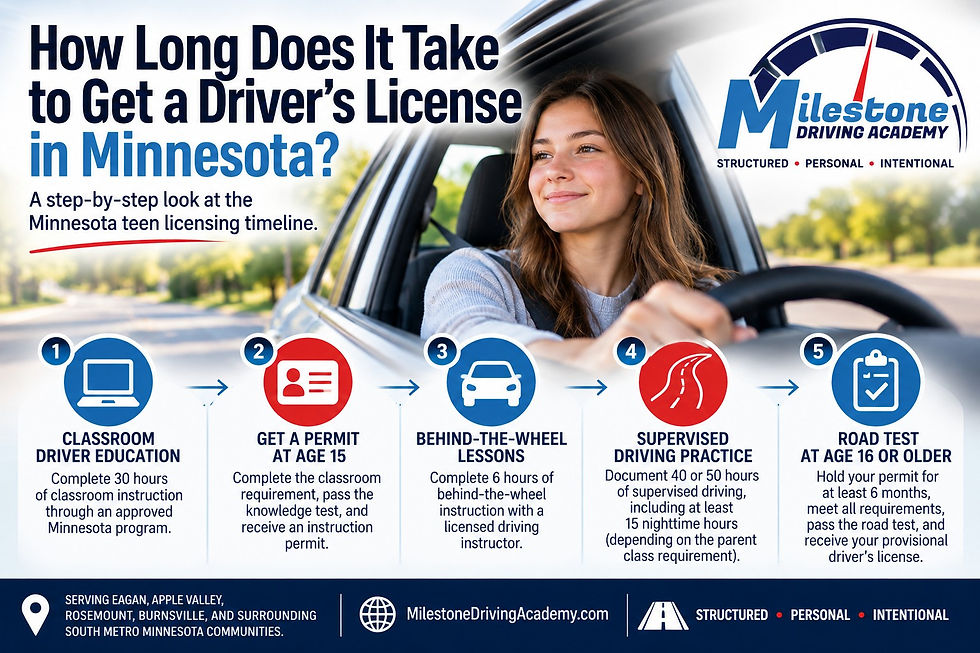
For most Minnesota teen drivers under age 18, the answer is at least 50 hours of supervised driving practice, including 15 hours at night.
There is one alternative. If a parent or guardian completes a qualifying supplemental parent class offered by a Minnesota-approved driver education program, the requirement is reduced to 40 hours of supervised driving, including 15 hours at night.
Those hours are an important part of Minnesota's graduated licensing process, but simply accumulating enough hours doesn't necessarily mean a new driver has gained the experience needed to drive independently.
What Counts as Supervised Driving Practice?
During the instruction permit period, teens complete their supervised practice with a licensed driver who is at least 21 years old and sits in the front passenger seat.
Families should keep track of this practice using a supervised driving log. Recording hours as you go is much easier than trying to reconstruct months of driving shortly before the road test.
The log can also be useful for looking beyond the total number of hours. Where has your teen been driving? What situations have they experienced? What still needs more practice?
Not All Practice Hours Are Equal
A teen could accumulate a lot of driving time by repeatedly traveling the same familiar routes. That can be useful, especially early in the learning process, but new drivers eventually need experience in a variety of situations.
As skills develop, practice should gradually include:
Residential streets
Busier city roads
Multi-lane roads
Different types of intersections
Parking and backing
Higher-speed roads
Nighttime driving
Rain and other appropriate weather conditions
Different levels of traffic
The goal isn't to expose a new driver to everything immediately. It's to gradually expand the student's driving experience as their skills improve.
Practice Should Become More Challenging Over Time
Early practice may appropriately focus on basic vehicle control, including steering, braking, turns, lane position, and speed control.
As those skills become more consistent, the driving environment can become more complex.
A student who is comfortable driving around the neighborhood may be ready for a busier road. Later, that student can begin working with heavier traffic, lane changes, higher speeds, and more complicated intersections.
There is no reason to rush that progression. New challenges should be introduced when the student is ready to manage them.
Use Practice Time With a Purpose
Parents don't need to turn every drive into a formal driving lesson. Some of the most valuable experience comes simply from having the teen drive during normal family trips.
It can still be helpful to have a purpose for certain practice sessions.
If a student is struggling with left turns, spend part of a drive working on different left-turn situations. If lane position needs improvement, choose roads that provide opportunities to practice it. If the student hasn't driven much after dark, intentionally plan some nighttime practice.
After a professional behind-the-wheel lesson, families can also use instructor feedback to identify specific skills that need additional attention.
Is the Minimum Number of Hours Enough?
The required practice hours are a minimum, not a guarantee that every student will be ready to drive independently.
Some students may develop the necessary skills and experience within the required practice time. Others may benefit from considerably more.
Instead of focusing only on the number recorded in the driving log, parents should consider the experience behind those hours.
Has your teen driven in unfamiliar areas? Can they comfortably handle busier traffic? Have they practiced at night and on higher-speed roads? Can they manage complicated intersections without relying heavily on instructions from the passenger seat?
Those questions can tell you more about a student's readiness than the number of hours alone.
Make the Permit Period Count
The permit period is about much more than filling in a driving log.
It's an opportunity for a new driver to experience different roads, conditions, traffic situations, and challenges while an experienced adult is still sitting beside them.
At Milestone Driving Academy, students receive six hours of structured behind-the-wheel instruction. The many additional hours spent practicing with parents and guardians provide the repetition and experience that help turn instruction into lasting habits.
For families in Eagan, Apple Valley, Rosemount, Burnsville, and surrounding South Metro communities, the goal shouldn't simply be accumulating the required practice hours.
The goal should be making those hours count.